A university people finder directory works as a centralized search system that connects verified campus listings across institutions. This college people finder enables fast lookup of students, faculty, and staff through structured academic records and directory data. It supports entity-based search signals that improve match accuracy for academic queries. The system aligns names, roles, and institutions using structured indexing. This method strengthens search relevance and delivers precise results across multiple university datasets.
The University People Finder Directory organizes public university data into a unified, search-friendly format. It supports precise queries using name, department, role, or institution, which improves relevance and reduces search friction. Semantic signals such as student directory search, faculty profile lookup, college staff directory, alumni database search, and university contact records help match intent with accurate results. It presents categorized listings, filters, and entity relationships that strengthen topical relevance and improve crawl efficiency. This approach increases visibility for academic queries and delivers consistent, high-quality results for users seeking campus-related information.
What is University People Finder?
A University People Finder is an online tool that helps users locate students, faculty, and staff through an official university directory search. It works like a campus-based search system where names, departments, or roles can quickly return relevant profiles. A campus people finder pulls data from internal records and organizes it into a searchable format. It supports student directory search tasks such as finding classmates, professors, or campus contacts.
How a University Directory Search Works
A university directory search collects and displays basic contact and identity details from a school’s database. Each university manages its own directory, often linked to campus systems like email or ID services.
Most directories follow a simple process:
- User enters a name or keyword
- The system scans its internal database
- Matching profiles appear with limited public details
These results may include:
- Full name
- Department or major
- Role
- University email address
- Office location
Some schools allow filters like graduation year or department. Others limit search results to protect privacy.
Types of Campus People Finder Systems
A campus people finder may vary by institution, though most fall into three main types:
| Type of Directory | Who It Includes | Common Use Case |
|---|---|---|
| Public Directory | Faculty & staff | Contact professors or offices |
| Student Directory | Enrolled students | Find classmates or peers |
| Internal Campus System | Full campus community | Used by students and staff only |
Public directories usually show limited details. Internal systems often require login credentials.
Why Universities Use Directory Systems
Universities maintain directories to support communication and campus operations. These systems help users find the right person without delays.
Common benefits include:
- Quick connection between students and faculty
- Easy lookup of campus departments
- Organized records for large institutions
- Support for collaboration and networking
Many universities update their directories often to keep records accurate.
How to Find People in Universities Online
Finding students, faculty, or staff in universities online becomes simple when official directories and search tools are used correctly. Most universities provide a structured faculty directory search system, and platforms like GMU’s People Finder support detailed queries using name, department, or email. At George Mason University, the People Finder directory includes students, faculty, and staff records in one system, making it a strong example of a student lookup tool used across campuses.
Start with the Official University People Finder Systems
Most universities run an internal directory that supports fast name-based searching. For example, GMU’s system allows searching by students, faculty, or departments through its online portal.
Search options usually include:
- Full name
- Department or academic program
- University email format
- NetID or username
- Job title or campus office
Example from the GMU system: users can type partial names like “zoya” and filter results for students only using the built-in search function.
Steps: Process for Finding Students in College
A clear process helps improve accuracy when using methods to find students in college across university databases.
- Open the https://peoplefinder.gmu.edu/?gmuw_pf_search=zoya&gmuw_pf_who=students
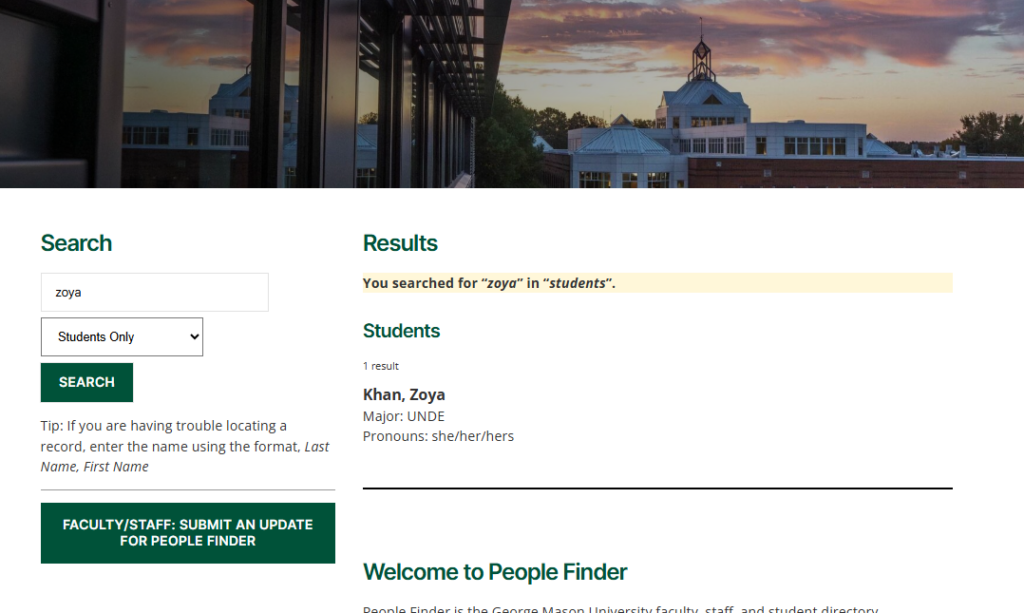
- The university’s People Finder or campus directory portal.
- Select the search category
- Choose options such as:
- Students only
- Faculty/Staff
- All users
Enter search details
Use one or more of the following:
- Full or partial name
- Department or program
- Email format or username
Apply filters
Filter results by college, role, or campus unit.
Review the profile listing.
Check available details like:
- Office location
- Email contact
- Academic role or enrollment status
Many systems also accept partial inputs, so even incomplete names can return matches.
Faculty Directory Search Methods for Better Accuracy
A faculty directory search often gives more detailed results than student records. Faculty profiles are usually public and structured in academic departments.
Common search methods include:
- Searching by last name first
- Entering department name (e.g., Computer Science, Business School)
- Using email username format
- Filtering by academic title (Professor, Lecturer, Assistant Professor)
Typical faculty directory data includes:
- Office location
- Email address
- Phone number
- Research areas
- Teaching department
At GMU and similar universities, faculty records are often easier to locate than student records due to privacy protections.
Top University People Finder Directories
Top university people finder directories help locate students, faculty, and staff across major U.S. campuses. These systems work as a college people finder and support a university directory search across public and private institutions. Each university manages its own directory, so search results and structure differ based on campus size and academic system. Public university systems often organize data in different ways, especially across multi-campus networks. Some schools separate students and staff, while others combine all listings in one database and on social media. This creates differences in search speed, filtering options, and profile detail levels across universities.
OSU People Finder
osu people finder helps users find faculty, staff, and academic contacts at Ohio State University. It is also known as the Ohio State People Finder in many campus search systems. Ohio State operates a large public university network with multiple campuses and departments. The directory supports name-based search, department lookup, and role-based filtering. This system connects users with email addresses, office locations, and academic positions across colleges like engineering, medicine, and business.
UMass People Finder
Umass People Finder works as part of the wider university directory search system used across the University of Massachusetts campuses. UMass includes multiple campuses such as Amherst, Boston, and Lowell. Each campus may show separate directory results tied to its own database.
Typical search options include:
- Name-based lookup
- Department listings
- Academic role filters
- Staff contact pages
This setup helps users separate results across different campuses inside the same university system.
Pitt People Finder
Pitt People Finder supports searches across the University of Pittsburgh network. It functions as a campus people finder tool for academic and administrative contacts. The system includes students, faculty, and research staff. It connects users to departmental listings across health sciences, engineering, and arts programs.
Elements:
- Faculty profiles with titles
- Department search filters
- Contact information display
- Campus office details
This structure helps organize a large academic environment into searchable segments.
Auburn People Finder
Auburn People Finder connects users with Auburn University staff and faculty listings. It supports campus-wide directory searches across academic and administrative departments. The system groups results by role and department. It supports quick lookup for faculty email and office details.
Common features:
- Faculty name search
- Department grouping
- Staff contact pages
- Campus role labels
Auburn’s system focuses on academic clarity across colleges such as business, engineering, and agriculture.
MSU People Finder
MSU People Finder is used at Michigan State University and supports a large academic network. It connects users with faculty, staff, and departmental listings across multiple colleges. The directory is structured to handle a large student population and diverse academic departments. Search options include name lookup, department search, and role-based filtering for faster results across campus systems.
GMU People Finder
Gmu People Finder works at George Mason University and supports academic directory search across multiple schools. It helps users locate faculty, staff, and department contacts. GMU includes colleges like law, business, and engineering, each with structured listings inside the system. Users can search by name, department, or academic unit to find email and office details.
Virginia Tech People Finder
Virginia Tech People Finder connects users to faculty, staff, and research contacts at Virginia Tech. It supports a large academic and technical campus structure. The directory covers engineering, agriculture, sciences, and more. Users can search by department or individual name.
Functions:
- Academic staff listings
- Department search tools
- Office location data
- Email directory access
Virginia Tech’s system supports both academic and research communication across multiple colleges.
Cornell & Rutgers Directory Search
Cornell People Finder and Rutgers People Finder systems support two major universities with different structures. Cornell operates as a private Ivy League institution, while Rutgers belongs to a large public university system. Cornell’s directory focuses on academic departments, research staff, and college divisions such as agriculture, business, and law. Listings often include faculty titles and research roles. Rutgers uses a public university system with multiple campuses across New Jersey. Its directory separates results by campus and department, covering faculty, staff, and academic advisors.
Common search features across both systems:
- Name-based search tools
- Department and school filters
- Faculty and staff profiles
- Contact and office listings
Differences between them reflect their academic structure. Cornell centers on smaller, research-driven listings. Rutgers covers a broader public system with multiple campus networks.
Student vs Faculty Directory Search
Student directory search and faculty directory search operate through separate campus data systems that store different types of records. The main difference between student & faculty search systems lies in the type of profiles, verification rules, and details shown in results.
How Student Directory Search Works
Student directory search focuses on enrolled learners within a university database. It pulls records from admission systems, course registration files, and campus ID databases. Search results usually show basic academic and contact-related details.
A typical student directory search includes:
- Full name and student ID
- Enrollment status
- Program or major
- Class year or expected graduation
- Campus email (if permitted)
Search filters often sort by department, program, or enrollment batch. Many systems limit visible data to protect privacy, so sensitive academic records do not appear.
How Faculty Directory Search Works
Faculty directory search pulls data from staff payroll systems, HR records, and academic appointment databases. It focuses on teaching staff, researchers, and administrative academic roles.
A faculty directory search may show:
- Name and job title
- Department affiliation
- Office location and contact extension
- Research areas or academic interests
- Published work links or profiles
Faculty records remain more stable compared to student records since employment changes less often. Many universities include public-facing profiles for academic networking and research visibility.
Campus People Finder Tools & Features
A campus people finder helps students, faculty, and staff locate individuals across a university network using a centralized directory. A student lookup tool allows a quick search of names, departments, and contact details within seconds. These tools improve campus communication by making people search faster, clearer, and more organized.
Core Features of Campus People Finder Systems
Campus people finder tools come with structured search options that support quick results. Users can find students, professors, or staff through simple inputs.
Common features include:
- Name search for direct person lookup
- Department filter for academic or administrative units
- Email-based search for verified contact details
- Role filter, such as student, faculty, or staff
- ID-based lookup for enrolled members
These features help reduce time spent on manual searches and improve accuracy across large university databases.
Student Lookup Tool Search Filters
A student lookup tool is built with smart filters that narrow results quickly. It works well in large universities where thousands of records exist.
Search filters include:
- Full or partial name search
- Department or major selection
- Class year filter
- Email or username lookup
- Location-based campus filter
These filters help users avoid long lists and find the right student record in fewer steps.
How Search Filters Improve Results Accuracy
Search filters play a major role in improving result precision inside campus people finder systems. They remove unrelated entries and focus only on matching data.
Common filter combinations:
| Search Type | Example Input | Result Type |
|---|---|---|
| Name + Department | “John Smith + Biology” | Specific student list |
| Email Search | “john@university.edu” | Single profile |
| Role + Year | “Student + 2027” | Class-based grouping |
| Department Only | “Computer Science” | Department directory |
These filters support faster navigation inside large university directories and reduce search errors.
Alumni Search Across Universities
Alumni search across universities helps locate former students using official records, digital databases, and alumni networks. A university directory search often connects users with graduation details, departments, and public professional updates. Alumni search systems focus on tracing former students through structured university records and alumni associations. A university directory search often pulls data from graduation lists, enrollment history, and public alumni networks. These tools support reconnecting classmates, checking career paths, and validating academic history.
How alumni records are organized
Most universities keep alumni data in structured formats. These records often connect student identity with academic timelines and departments.
Common data points include:
- Full name at enrollment
- Graduation year
- Degree program or major
- Alumni association membership status
- Public professional links
Many institutions also link alumni portals with networking platforms, making alumni search more dynamic and updated.
Methods used in the university directory search
Different methods support a university directory search system. Each method depends on data availability and privacy settings.
- Name-based lookup: Finds records using full or partial names
- Batch search tools: Filter alumni by year or department
- Department listings: Shows graduates grouped by academic field
- Alumni network portals: Connects verified former students
- Public professional links: Uses shared career profiles
These methods often overlap, giving users multiple entry points for the same record set.
Value of alumni search systems
Alumni search tools help in several real-life situations:
- Reconnecting with former classmates
- Checking academic background for networking
- Tracking career movement trends
- Verifying graduation details in public records
Many universities now maintain digital alumni directories, making records easier to locate while keeping privacy settings in place.
Is University People Finder Safe and Legal?
University people finder systems are legal when they pull data from public or authorized university directories. Public directory search tools operate within privacy rules set by institutions and data protection laws. University people search legality depends on how the data is collected and displayed. Most platforms rely on public records, alumni listings, or consent-based databases maintained by universities. These systems do not operate outside legal boundaries when they follow institutional and privacy rules.
Public directory search and data sources
Public directory search systems usually pull information from verified academic sources. These sources are controlled by universities or officially approved networks.
Typical data sources include:
- Public alumni listings
- University enrollment directories
- Graduation announcements
- Faculty and staff listings
- Opt-in professional profiles
Since this data is already public or consent-based, it stays within legal sharing limits.
University people search legality factors
Several factors shape legality in university people search systems:
- Data origin: Only public or consented records are used
- Privacy controls: Users may opt out of listing
- Institution policies: Each university sets its own sharing rules
- Data protection laws: Compliance with regional regulations like FERPA in the U.S.
FERPA, for example, limits the release of private student education records without permission.
Safety considerations in public searches
Safe use of public directory search tools depends on responsible handling of information.
Points include:
- Use data for personal or academic networking
- Avoid misuse for commercial targeting or unauthorized profiling
- Respect privacy flags set by universities
- Rely on verified university or alumni platforms
Most university people finder systems operate within strict academic and legal frameworks, keeping records structured, transparent, and policy-compliant.
FAQs About University People Finder Directory
Many users search university people finder tools to quickly locate students, faculty, and alumni using only a name or department. These systems pull academic listing data from official university records and public campus directories, which makes them useful for fast profile checks. Search results usually depend on what each university shares publicly, so some profiles may show full details while others show only basic information like name and department.
How do I find students in a university?
Finding students in a university usually starts with a name search inside the official university directory. Users can type the full name or partial name, and the system shows matching student records linked with departments or programs. Some universities also offer filters like admission year or major to narrow results. This helps reduce confusion in large campuses where thousands of students are enrolled. In some cases, student profiles may be limited due to privacy settings set by the institution.
What is a university people finder?
A university people finder is a search system that lists students, faculty members, and staff connected to a specific institution. It works like a digital directory where users enter a name and receive matching academic profiles. These systems are often connected to official university databases, which helps keep information organized and structured. The results may include job title, department, and contact details if the university allows public display. It is mainly used for academic communication and internal networking.
Can I search for faculty by name?
Faculty members can usually be searched by name in most university directories. When a user enters a professor’s or staff member’s name, the system displays their academic position, department, and sometimes office contact details. Some universities also show research areas and published work linked to the faculty profile. This makes it easier for students and researchers to connect with the right academic expert. However, details may vary depending on the university’s privacy policy.
Are university directories public?
Many university directories are publicly available, but the level of access is different for each institution. Public directories often show faculty and staff listings, while student information may be partially hidden for privacy reasons. Some universities only display basic identity details like name and department. Others provide extended profiles with emails and office locations. This depends on how the institution manages data sharing policies and public access rules.
How accurate are student lookup tools?
Student lookup tools are generally accurate because they pull data directly from university records and internal databases. However, accuracy depends on how often the university updates its system. Active students usually have up-to-date records, but recently changed or inactive profiles may take time to reflect changes. Some directories also limit visible information, which can affect completeness. Still, they remain reliable for basic academic search needs.